


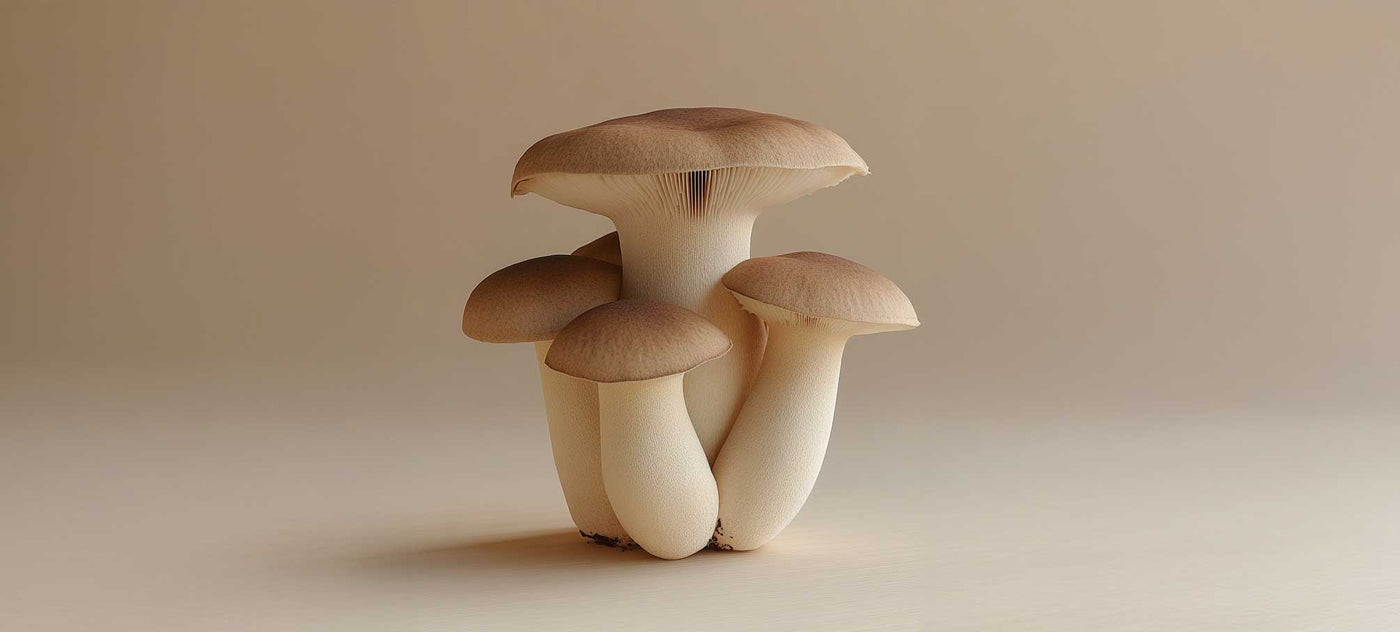

KING OYSTER MUSHROOM ESSENTIAL NOTES
The king oyster mushroom contains a variety of naturally occurring nutrients, including phenolic compounds and ergothioneine.
Culinary and Botanical Value
P. eryngii is an edible mushroom species native to Western Europe, Central Europe, Central Asia, and South-West Russia. It is one of the most highly valued species of the genus Pleurotus (along with Pleurotus ostreatus).
Traditional Composition
As with many traditional edible fungi, its composition includes naturally occurring enzymes and organic compounds. Consequently, its cultivation has expanded globally as a valued culinary mushroom.

DOCUMENTATED APPLICATIONS AND USES
Like Shiitake and Maitake are increasingly valued both as a culinary ingredient and for its nutritional composition. Fungi are recognized as a natural source of nutrients, including polysaccharides (such as beta-glucans).
Polypeptides and Biomolecules
Researchers have studied the polysaccharides and polypeptides (such as PEMP) found in P. eryngii to better understand their natural structure and composition. While fresh mushrooms provide these nutrients as part of a balanced diet, food supplements offer option forms such as powders or extracts containing concentrated mushroom biomolecules
Products with Pleurotus eryngii
-

 TOP SELLERSHasta - 10 %
HIFAS-Microbiota (Lion’s Mane, Oyster, Reishi, Shiitake) capsules
GUT COMFORT SUPPORT
From 40,30 €42,50 €Unit price /Unavailable -


Bio Defense (Oyster, King Oyster, Lion’s Mane, Reishi and Shiitake powder) capsules
ORGANIC MUSHROOMS + VITAMINS C & D
32,00 €Unit price /Unavailable


THE CULTIVATION OF MUSHROOMS
Pleurotus eryngii is an edible mushroom cultivated across Europe, Asia, and North America. Widely valued for its culinary characteristics, it can be grown on various organic substrates such as hardwood sawdust or straw. When cultivated for food supplements, controlled environmental parameters and certified organic substrates are used to ensure consistency and quality.
Featured Biomolecules
The basidiomycete P. eryngii contains proteins, poly saccharides, unsaturated fatty acids, and other nutrients. P. eryngii has active biomolecules, the most important of which are:

Do you want to know more?
Habitat and distribution
Habitat and distribution
Eryngii mushrooms usually grow in chalky soil, especially where there are remains of wild thistles, which serve as food for their mycelium. They are found in Europe and Asia, but also in some regions of Africa, as they prefer warm environments.
Mycological notes
Mycological notes
This species displays a morphology similar to P. ostreatus. In this case, the cap ranges from 4 to 10 cm in diameter, and the predominant colour of the cuticle is brown, which lightens as it matures. Its gills are white initially, darkening to a cream colour over time. The flesh is white, firmer than in other Pleurotus species, with a pleasant aroma and mild, sweet taste. The stem is one of the most characteristic elements of this species: it is white, ringless, and has firm flesh.
The culture in bioreactors
The culture in bioreactors
Quality, Purity, and Consistency in Our Production Systems
One of the primary Hifas da Terra research lines focuses on the continuous development of bioreactor cultivation across key species (Reishi, Lion's Mane, Shiitake, and Maitake) using certified organic substrates, as well as the standardization of raw ingredient quality to ensure high standards in every mushroom formula.
Hifas Quality System
Through our dedicated quality standards, we identify key biomolecules, select specific strains of fungi, employ proprietary analytical methods, and follow strict protocols for testing across all production phases. Thanks to this rigorous approach, we offer natural food supplements with the HIFAS QUALITY SYSTEM, ensuring consistency, purity, and premium standards across our range.
R&D and thistle mushroom studies
R&D and thistle mushroom studies
Quality, Purity, and Consistency in Our Production Systems
Our commitment to excellence is reflected in our strict quality assurance standards, ensuring purity and consistent quality across our products.
Curiosities
Curiosities
- This species appears in the writings of Pliny the Elder (AD 23–79), who provided information on the harvesting and use of mushrooms associated with thistle roots (Pleurotus eryngii).